Case Study:
Toyota Parts Management Delivers Productivity Gains with Lattice Technology Solutions
A NEW PARADIGM FOR LEVERAGING 3D DESIGN DATA IN MANUFACTURING
A CASE STUDY FEATURING TSUNEISHI SHIPBUILDING AND TOYOTA FOR IMPROVING MANUFACTURING QUALITY AND SPEEDING TIME-TO-MARKET USING XVL®.
— Using Lattice Technology solutions, engineers and non-engineers easily simulate assembly processes and create work instructions or technical illustrations—directly from 3D engineering data. —
 No one disagrees that using 3D models for communicating, planning and validating is better than using 2D drawings. The question is how do you use 3D models effectively. The issues center on the following:
- Complete Product – Including all subassemblies and parts
- Performance – Overcome compute performance issues for loading and working on the models
- Accuracy – Models with CAD-level accuracy for validation
- Attached Documentation – Authoring of related information that is attached to parts and assemblies
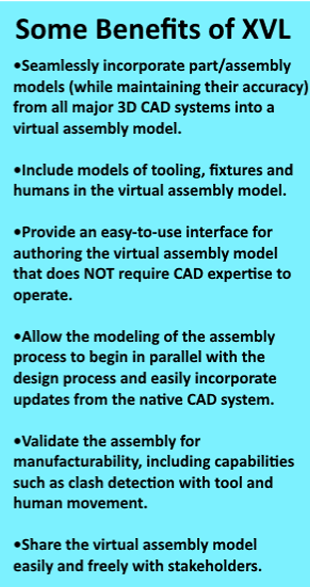
XVL® from Lattice Technology is a 3D CAD agnostic solution that addresses these issues and allows manufacturing companies to repurpose 3D design data into their organization and supply network for uses such as:
- Manufacturing assembly planning & validation
- Technical publications including manuals
- Spare part ordering
- Service documentation
This case study focuses on the optimizations achieved in manufacturing assembly by two companies that use XVL, the Toyota Motor Company and Tsuneishi Shipbuilding.
TSUNEISHI
Tsuneishi Shipbuilding: Improves quality and accelerates manufacturing through assembly process validation and interactive 3D work instructions using XVL from Lattice Technology.
Tsuneishi Shipbuilding Co., Ltd builds carrier ships for transporting crude oil and other types of cargo around the world. These massive carriers are well over 300 yards in length and often take 2 ½ - 4 ½ years to build. Each carrier consists of several hundred thousand parts that must be assembled with sub-inch level accuracy.
Challenges: No prototypes, overseas production and language barriers
Although the company’s headquarters are in Japan, it also has factories in China and the Philippines in order to take advantage of the most cost-effective manufacturing facilities and workers. Yet building such large and complex ships overseas does pose some challenges. Particularly in the Philippines, many workers are not experts in complex assembly and the language barrier also presents some issues.
Another challenge is the fact that no prototypes are available for a ship this size. Instead, ships are all built based on the “Tsuneishi Economical Standard Ship” (TESS), and then each is customized for individual customers. In some cases, hundreds of ships are made from one standard ship. That means if there is an error with the standard ship, every ship built thereafter will have that same error. This means that the assembly validation process is critical, and it must be undertaken early in the design and manufacturing process.
Initially, Tsuneishi attempted to combat both of these challenges using 3D CAD and work instructions on the shop floor. Although this helped improve the situation, it didn’t solve the complete problem. Assembly validation was not taking place early enough in the design process, and workers on the shop floor still couldn’t understand the assembly process well enough to avoid errors.
Lattice 3D XVL: Solves validation issues and language barriers
In 2007 Tsueishi introduced Lattice3D’s XVL technology to improve the design review process using virtual validation of the manufacturing process and shop floor assembly instructions of their carriers at overseas factories. XVL allowed Tsueishi to create a virtual assembly model in order to optimize the carrier’s design early in the design process and better plan the manufacturing process. It also solved the communication problem, because the interactive 3D with associated work instructions transcended language barriers.
Because XVL is almost 1/100th of the original CAD data, Tsueishi was able to work with the model of the entire ship; compacting tens of gigabytes of CAD model data into several hundred megabytes of XVL data. At the same time, the precision of the data remained, allowing them to validate the design down to less than an inch.
Additionally, the easy to understand interactive 3D visualization of the assembly process with associated work instructions provided the shop floor workers with a much better understanding of their tasks. Even those workers completely new to ship building could understand what was expected and how to perform their work.
Conclusion
By introducing XVL based work processes, in addition to 3D CAD, Tsuneishi has accomplished their objective to perform detailed design review and validation sooner, before starting manufacturing. This has led to finding problems before starting manufacturing – when the problems can be corrected more quickly and at less cost.
TOYOTA
Toyota Motor Corporation: Improves manufacturing process planning and quality using XVL from Lattice Technology
The Toyota Motor Corporation® is a world leader in the automotive industry. The Company's automotive segment includes the design, manufacture, assembly and sale of passenger vehicles, minivans and commercial vehicles, such as trucks and related parts and accessories.
Virtual manufacturing process planning
At Toyota’s Motomachi Plant, Japan, the car manufacturer uses XVL from Lattice3D to engage the manufacturing stakeholders early – during the actual design process. The process uses the entire vehicle model with all parts and subassemblies. This is made possible because the XVL data model is less than 1% of the original CAD model, while still maintaining accuracy.
Designers at this Toyota plant can do the following:
- Verify assembly feasibility for each component in the assembly sequences
- Confirm the installation of large parts such as the engine
- Check the work space for tools and technician posture
- Ensure the completeness of the assembly line
- Capture the check results in reports
Manufacturing quality planning during design
Toyota knew that overall quality could be increased by engaging manufacturing stakeholders in the design process – when changes are less costly and can be made more easily. By engaging the stakeholders who actually perform the assembly, they can virtually plan the assembly process during the design phase. This capability lets product designers discover modifications that can streamline and/or increase the quality of the manufacturing process. Additionally, they may gain insights that eliminate manufacturing issues or identify product design changes that will speed manufacturing or improve product quality.
The potential quality of manufacturing is also evaluated during the design phase using a variety of verifications to confirm processes. These include:
- Reliability, such as abnormal noise and source of potential fire problems
- Manufacturability
- Visibility of vehicle frame number
- Dynamic movement of tools/operators to ensure quality
- Additional processes that continually capture and verify design intent
Conclusion
For Toyota, improving the quality is a goal for the entire company, and looking at the vehicle quality from the production engineering perspective has helped to achieve this goal.
Originally, Toyota was a customer of Lattice Technology. Since that time, they have become a major shareholder.
LEARN MORE FOR YOUR COMPANY
To learn how XVL can benefit your company, click here or call us at USA 720.330.3197.
Want to Learn More?